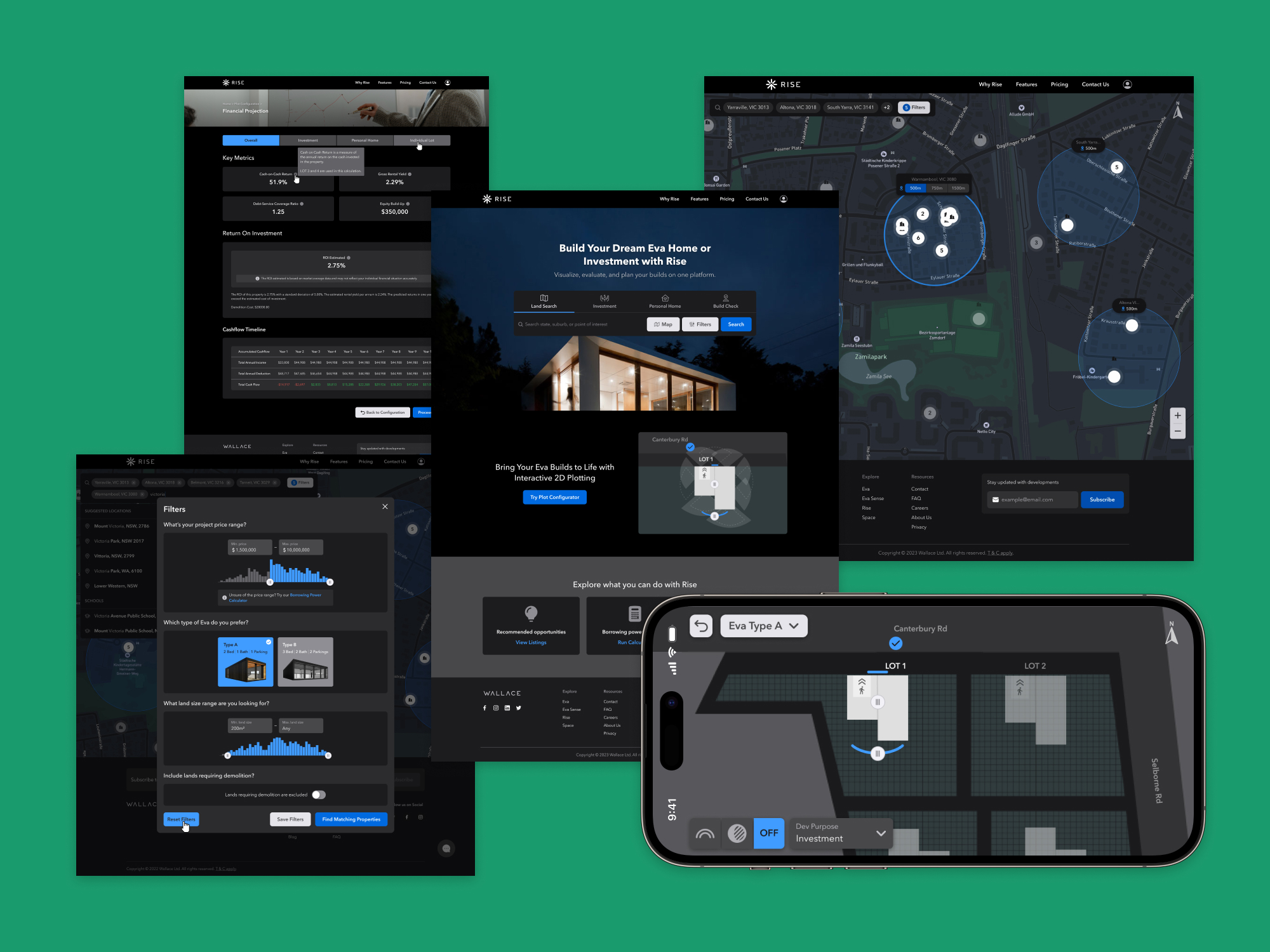
Two completely different users. One tool that served neither.
Rise is an urban planning tool for Eva's prebuilt smart home product. Property developers evaluate ROI, land yield, and subdivision potential. Individual buyers explore home placement and lifestyle fit. The platform forced both through the same path, and was failing at both.
Expression of Interest submissions had stalled. This wasn't a UX problem. It was a sales pipeline problem. Every confused user who abandoned the tool was a lost conversion.
Three threads before a single screen changed.
Discovery ran across three threads. First, I reviewed roughly ~40 stalled EOI submissions flagged by the Wallace sales team. Most failures clustered at plot selection, where the tool offered no feedback about feasibility and no way to compare options.
Second, I joined three weekly sales-pipeline reviews to watch objections live. Developer stakeholders pushed back on multi-plot configuration; individual buyers dropped at pricing transparency. The same screen was producing two completely different failure modes.
Third, I ran six 45-minute calls with developer stakeholders (across three property firms) and four calls with individual property buyers. The finding that shaped the dual-path decision: developers and individual buyers were failing at the same screen for opposite reasons. Developers needed multi-plot configuration control, while individuals needed pricing context before they could commit to placement.
One tool, two audiences, two separate failure modes. The research made the dual-path structure non-negotiable.
Mapping Divergent Journeys
I collaborated with software engineers and a machine learning engineer to map the optimal user journey. We identified two distinct entry models: the same data (land, placement, configuration) serving fundamentally different decision-making processes:
Search-First Path
Users with clear criteria
Price range, ROI targets, land size: browse and filter available opportunities with specific parameters in mind.
Purpose-First Path
Users starting with a goal
Residential, mixed-use, investment: the system matches them with suitable properties based on development intent.
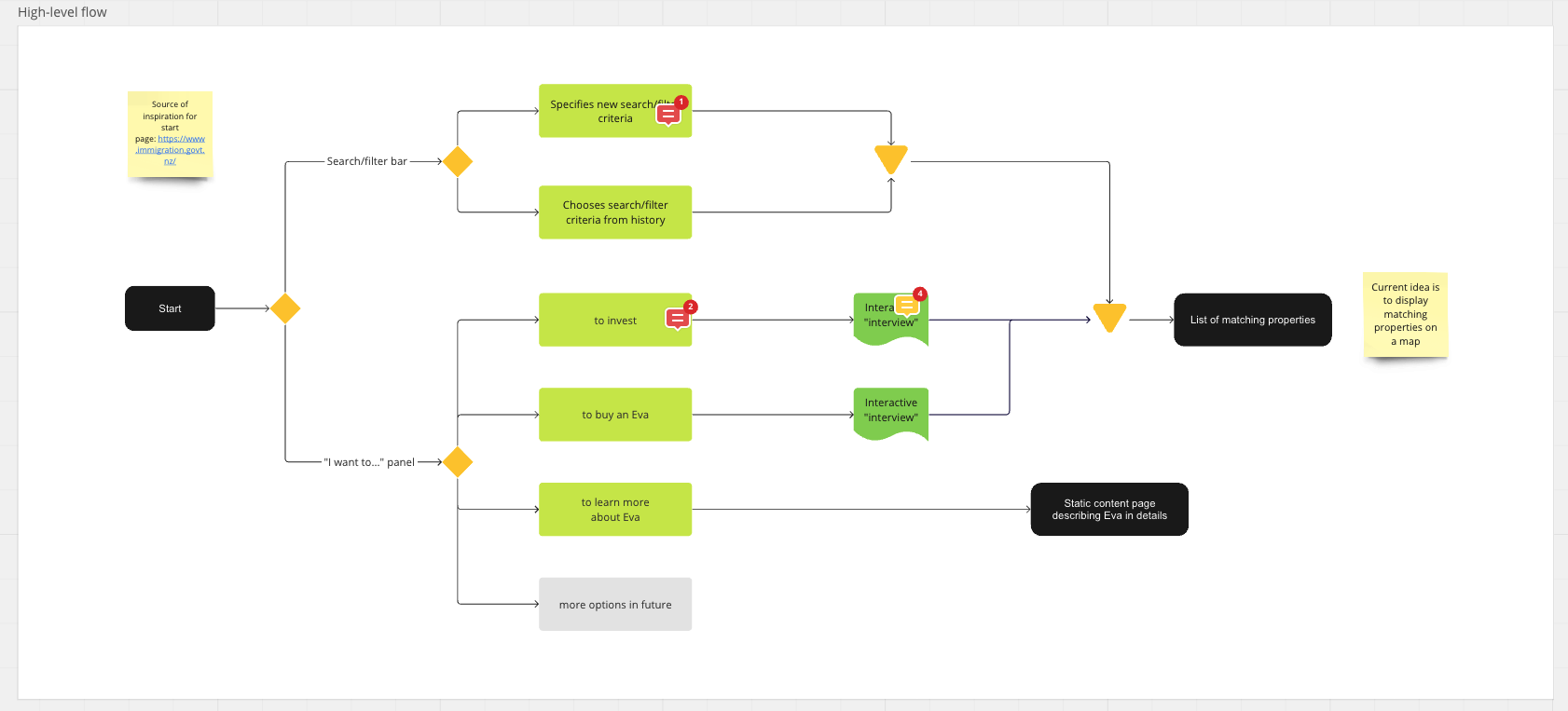
Initial userflow defining the two main user paths
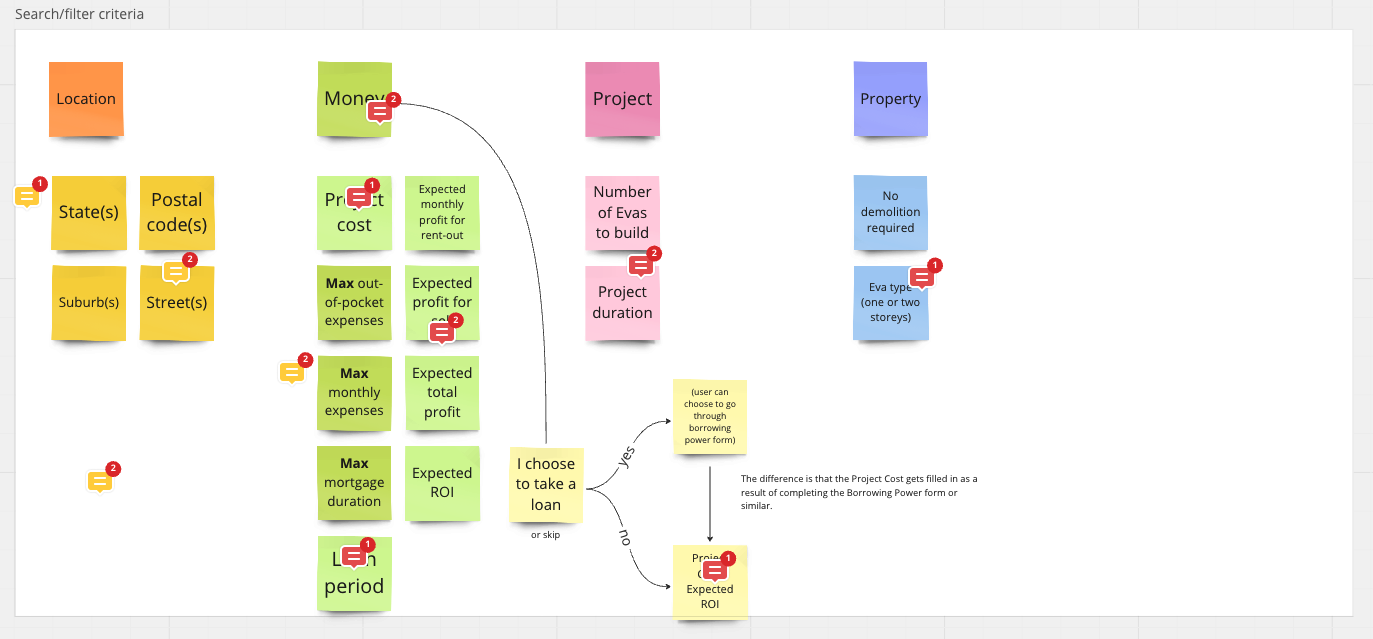
Brainstorming search and filter criteria for property matching
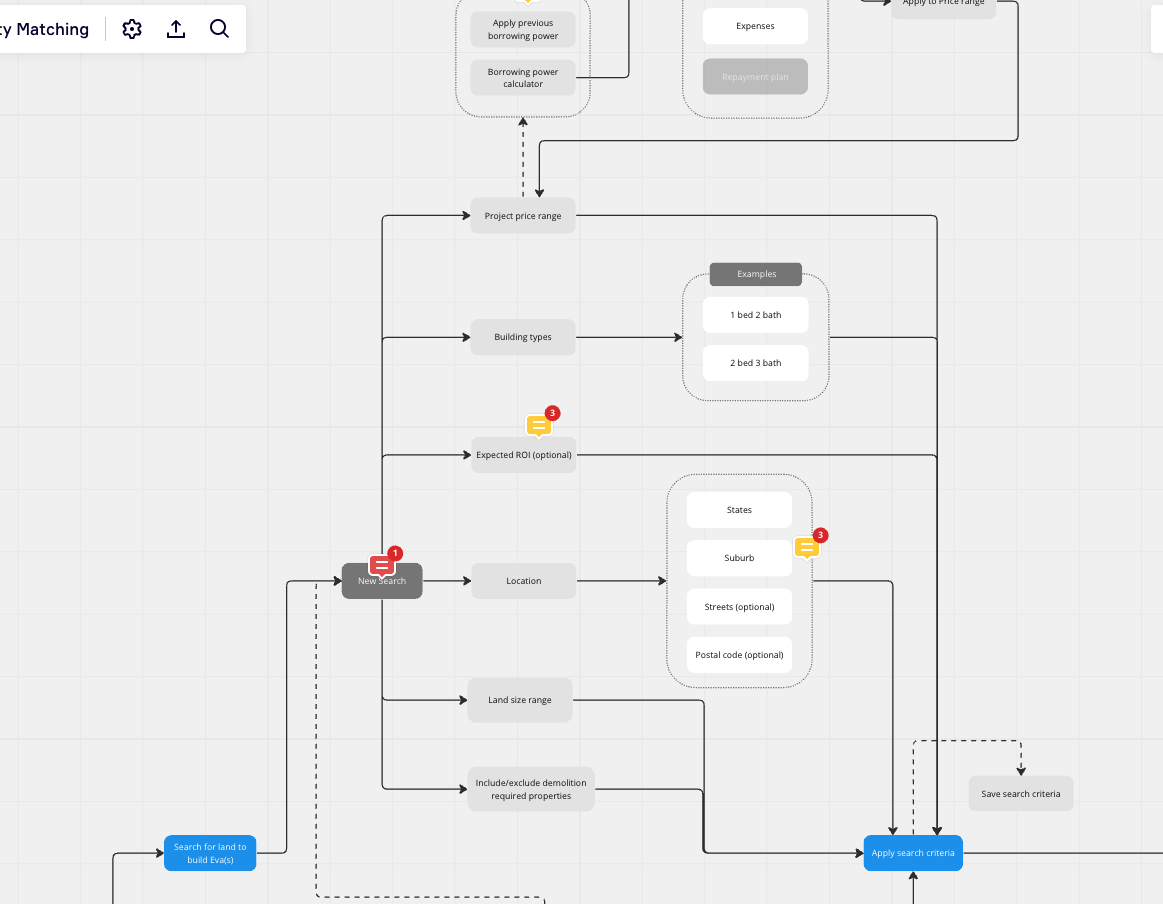
Detailed search flow with filters and property exploration
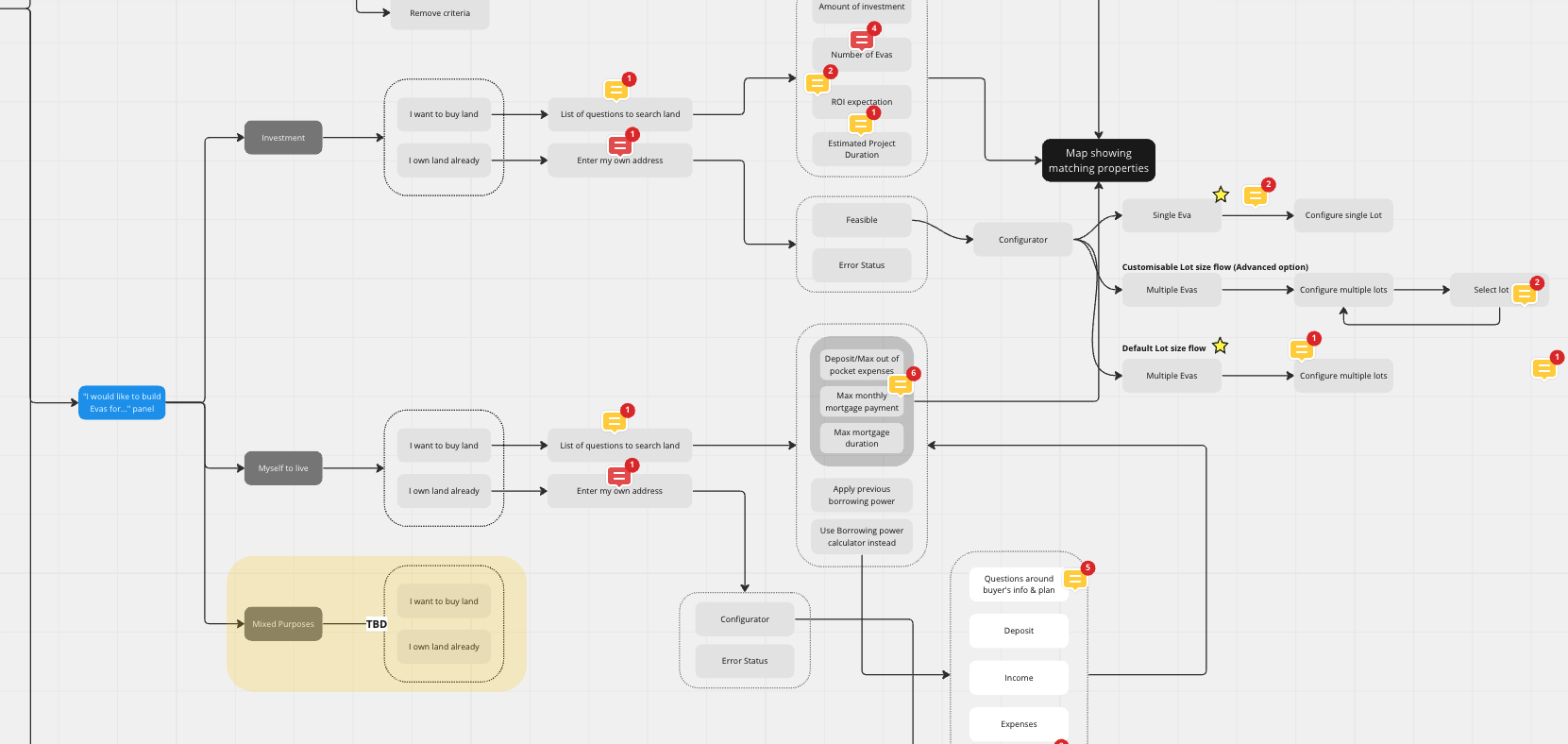
Purpose-based flow matching opportunities to development goals
Visual direction, then team execution.
Lo-fi mockups sparked productive discussions with stakeholders and enabled rapid iteration, aligning engineering, product, and business teams before committing to high-fidelity design.
I established the visual direction aligned with Wallace's dark, futuristic brand aesthetic and led a contract designer, delegating specific screens while maintaining regular syncs for cohesive output.
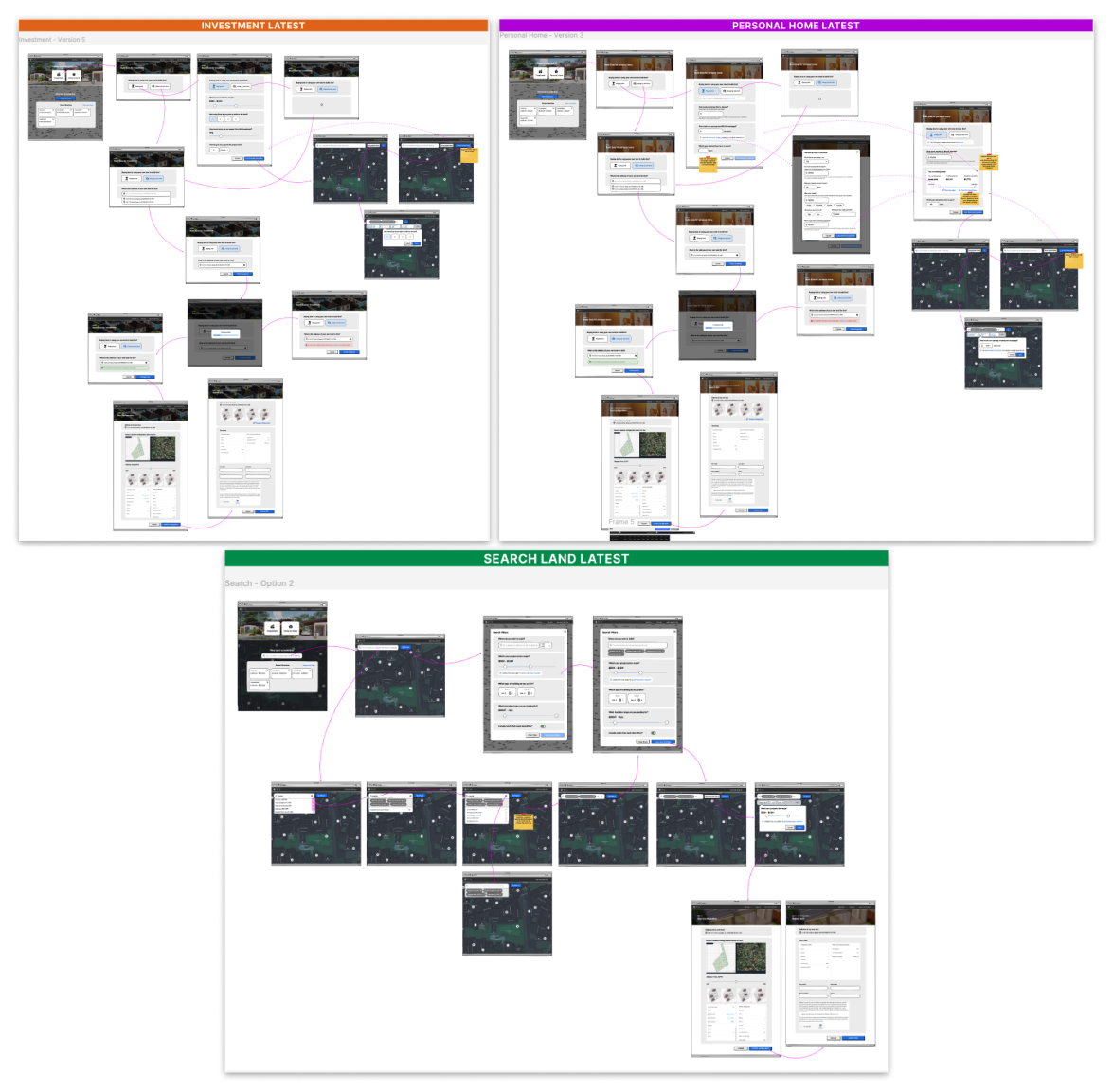
Low-fidelity mockups covering each Rise userflow
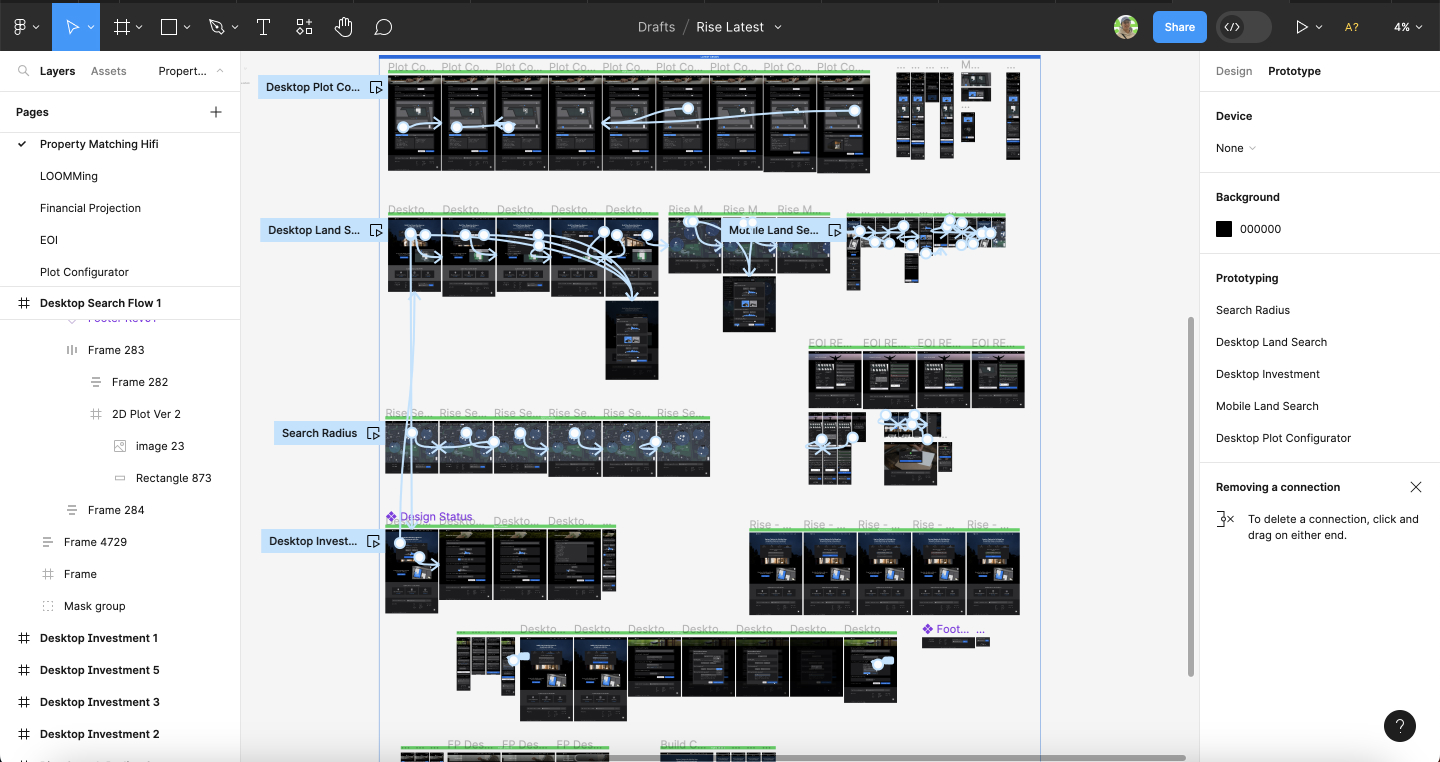
High-fidelity mockups: dark futuristic aesthetic with clear information hierarchy
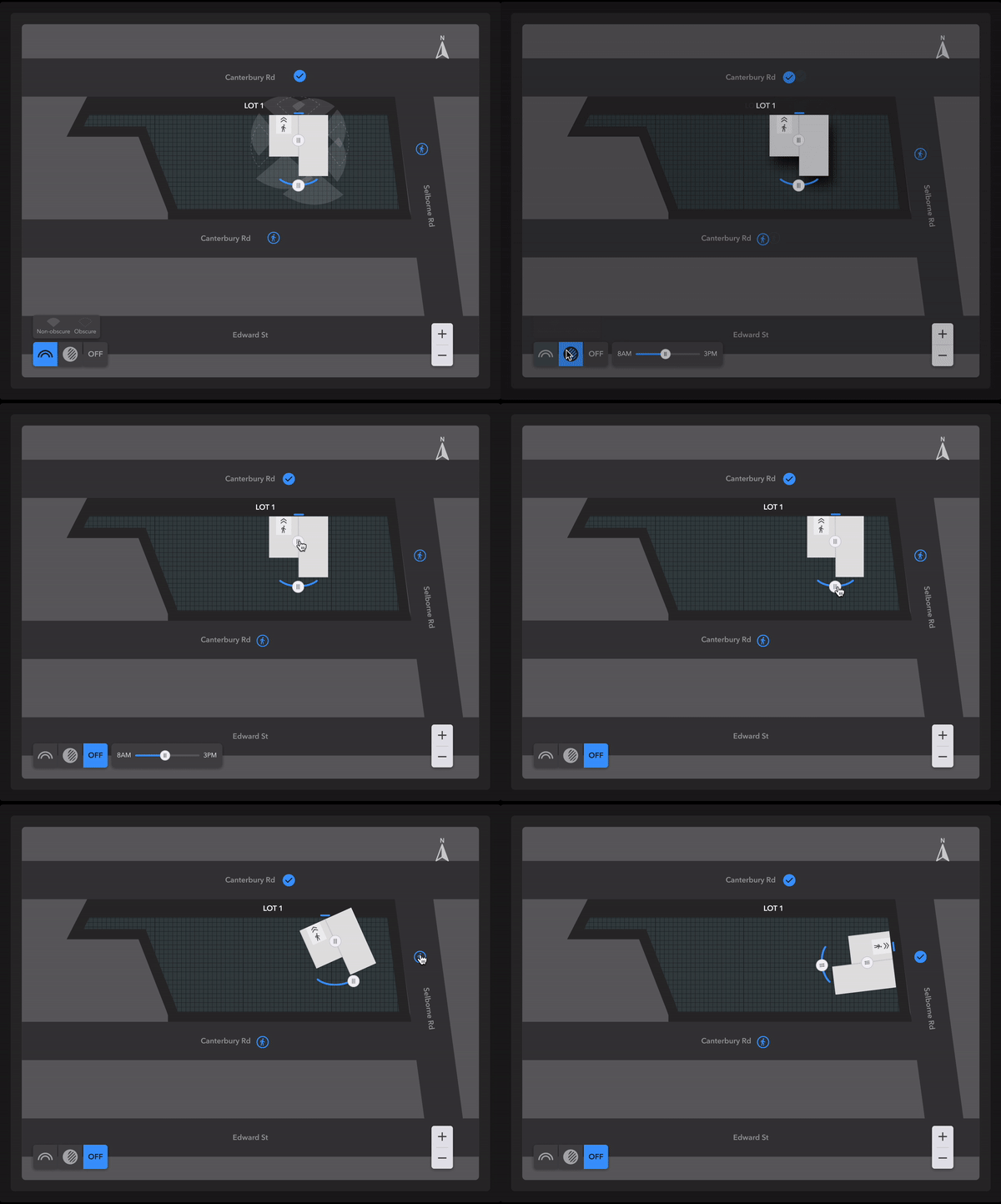
Plot Configurator: the thing that differentiated Rise.
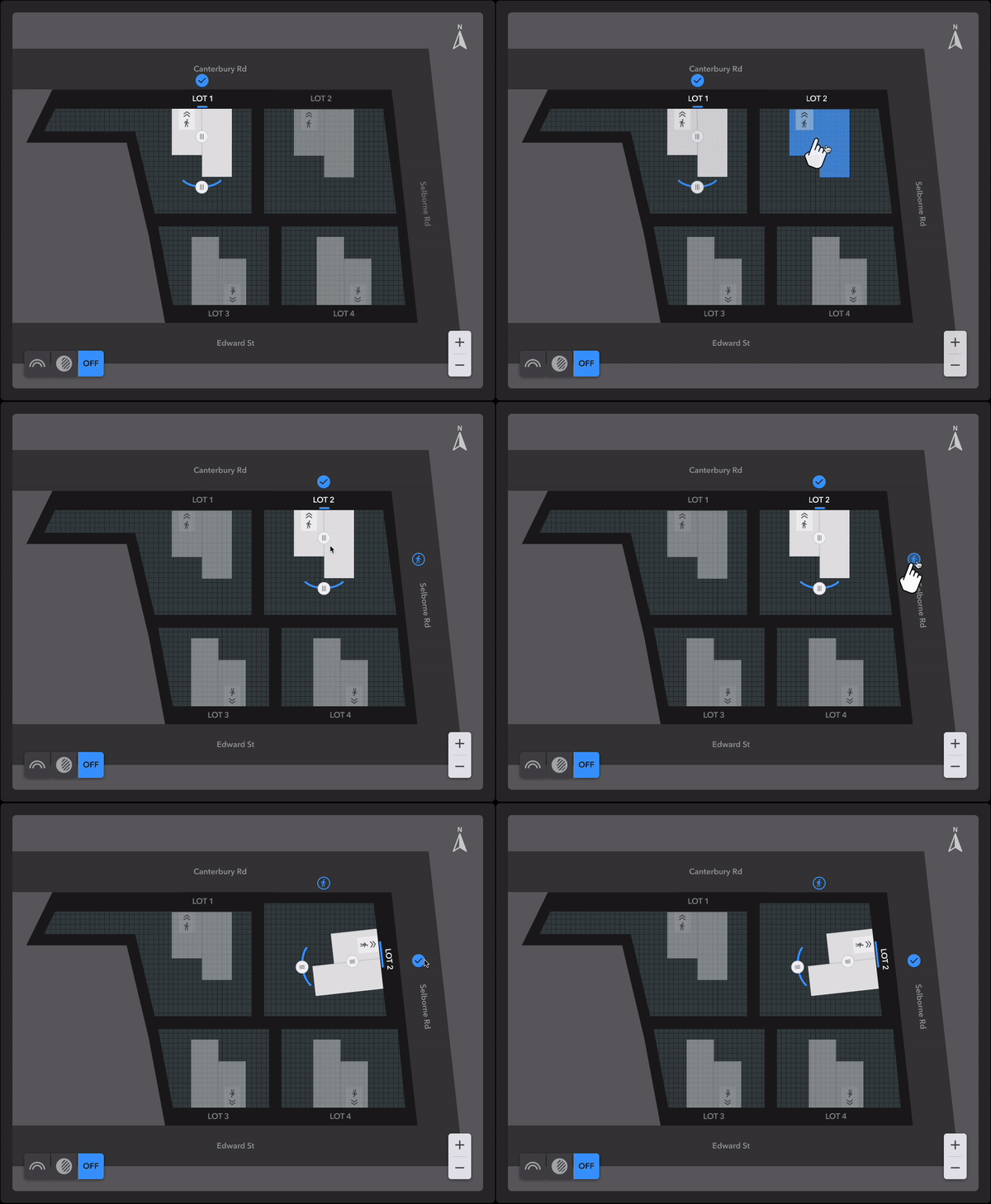
An interactive tool letting users customise Eva development plans with precision. I designed these interactions to be powerful for developers yet approachable for individual buyers:
Viewing Perspectives: including privacy-optimised obscure views
Shadow Casting: real-time sun position simulation
Placement & Rotation: positioning within feasible regions
Land Subdivision: divide plots and configure individual lots
From conversion blocker to conversion engine.
Read the numbers below as directional, not causal. A marketing push ran in the same window, and the sales team was newly trained on the plot configurator flow. I'm putting them on the page because the direction matched what the discovery predicted.
~18% EOI lift, individual cohort
Post-launch first quarter, quarter-on-quarter, per Wallace sales team feedback. Not controlled analytics; this comes from sales team feedback and pipeline review data.
~3 days → ~1 day, developer onboarding
Standard configuration conversations shortened, per sales team observation. The Plot Configurator reduced back-and-forth on feasibility.
Both failure modes the discovery had named, individual buyers dropping at pricing transparency and developers dropping at multi-plot configuration, moved in the right direction in the first post-launch quarter. The Plot Configurator became the feature that differentiated Rise from static property listing platforms.
What I owned. Dual-path UX definition: the decision to split developer and individual buyer journeys, and the logic defining when each path applies. Plot Configurator interaction design. Visual direction aligned to Wallace's brand. Management of the contract designer executing screens under my direction: I decided, they executed.
What sat with others. Software engineers and the ML engineer owned implementation, the technical roadmap, and the model work powering the configurator's feasibility logic. Wallace stakeholders owned commercial requirements and pricing decisions. The contract designer executed screens. Creative direction and decisions sat with me. I call that boundary out explicitly.